
Università degli Studi di Pavia
Centro Interdisciplinare di Bioacustica e Ricerche
Ambientali
Via Taramelli 24 - 27100 Pavia - Italy
e-mail : cibra@unipv.it
The history of the CIBRA Digital Signal
Processing Workstation
Before the establishement of the Centre
in 1989, bioacoustic research has been carried out at
the Institute of Entomology. The activities began in
1980 with the developement of a computer based digital
spectrograph. The first one in Italy dedicated to the
study of animal vocalizations; it was developed within
my thesis for getting the degree in Natural Sciences.
The system was based on a desktop computer Tektronix
4052 (64K RAM, 300K tape storage, monochromatic
graphical screen - the famous Tektronix storage tube,
fast Basic interpreter in ROM) interfaced (IEEE-488)
with a Bruel & Kjaer 2033 spectrum analyzer (10K
samples memory, 12 bit AD converters, maximum sample
rate 51200 samples/sec to get 20kHz bandwidth, 1024
points FFT, real-time display up to 2kHz) for signal
acquisition and analysis. The system also included a
disk unit Tektronix 4907 (three 5" floppy disks, 630K
each), a Tektronix 4611 hardcopy unit (black &
white, no shades) and a Tektronix 4663 plotter. The
sound source was a portable open reel recorder SONY
TC510-2.

From left to right: Tek 4611, B&K 2033, Tek 4052,
Tek 4907, Tek 4663
This system allowed the first
experiments of digital analysis on animal sounds in
Italy. A series of programs was developed to perform a
number of different tasks, including: acquisition of up
to 60K samples (six 10K samples consecutive frames by
means of pre- and post- triggering facilities available
on the B&K analyzer), signal storage and retrieval,
signal editing, waveform and envelope display,
instantaneous spectrum and cepstrum, formant analysis,
signal filtering by means of FFT forth and back
transformation, spectrogram on up to 10K samples,
frequency tracking, 3D waterfall display.
In the first version of the software, a monochromatic
spectrogram on 10K samples (0.2 sec duration and 20kHz
bandwidth at 51200 s/sec) required 40 minutes to be
computed and displayed. Later, the use of a Tektronix
FFT ROMPACK with optimized FFT routines allowed to
reduce the computation time to about 15-20 minutes for
each 10K block.
Initially, the programs were mainly used for
experimentation, bird song analysis and microseismic
studies. In 1984 the first analyses on fish sounds
(recorded at the University of Parma by Prof. Patrizia
Torricelli) were made and opened the pathway to
underwater bioacoustics.

Printout of a bird song (1981). The image is made by
assembling 6 screen hardcopies (3 for the spectrogram,
3 for the modulation curves).
In 1985, after getting the degree in
Natural Sciences in 1983, the programs were rewritten in
FORTRAN on a HP 1000 (128K RAM, 5MB removable HD, 10 bit
AD converter, 512x512 pixels color graphic display) made
available by the Dept. of Electronics of the University
of Pavia. I am very grateful to Prof. R.Schmid, chief of
the Department in that period, for having allowed me to
use all the instruments without any restriction. That
powerful instrumentation allowed the development of
several new procedures, including continuous signal
acquisition and HD recording, easy and fast signal
retrieval and display, colour spectrograms, color
manipulation on displayed images, wider control on
analysis parameters, moving cursors to take measures on
the spectrograms (time, frequency and dB readings), and,
overall, speed! Few minutes to get a 0.625s spectrogram!
While developing software on that system, I had the
honour to see at work a Laben computer with 16Kbytes of
"ferrite doughnut" RAM, a paper tape reader for programs
and data I/O, an oscilloscope for graphical output.
 |
 |
Envelope display for signal retrieval
and colour spectrogram of a signal frame (1985).
The emerging Personal Computers, even
if limited in their performances and very expensive -
more expensive than a car -, suggested me to start
developing a personal sound analysis system.
The very first attempt was in early 1986 with a
wonderful Sinclair QL (QL meant Quantum Leap...); small,
thin, black, lightweight, with 128K of RAM and a
Motorola 68008 inside. Its powerful procedural Basic in
ROM allowed the first experiments and the development of
a skeleton of the new software. Very soon, I switched to
a Pascal compiler and a 68000 Assembler to get speed. I
rewrote the programs; they worked fine on synthesized
signals, but, unfortunately, I never bought an AD
converter to work with real sounds.
In late 1986 a further definitive
leap towards the emerging PC architecture: an Olivetti
M24 (Intel8086 CPU, i8087 FPU, 8MHz, 256K RAM, 20MB
HD, an EGC graphic board with 640x480 pixels and 16
colours) equipped with a Data Translation DT2801
signal acquisition board (27ksamples/sec maximum
sample rate, 12 bit AD converter, DMA) for sound I/O.
Just to get few % of speed increase I replaced the
Intel CPU with a compatible NEC CPU.
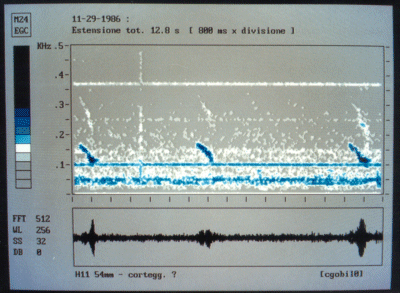
Spectrogram of courtship sounds
emitted by the goby fish Padogobius martensi made on a
8086 PC (1986)
Rewriting the whole software, as well
as optimizing it for the new hardware, was a big
challenge. I spent a lot of time to make it running. I
was very lucky to find a wonderful book ("8087
Applications and programming for the IBM PC and other
PCs" written by R.Startz, published by Brady in 1983)
and after reading it I gave a boost to the software by
writing most of the critical routines in Assembler 8086
and 8087. Then, the shell of the program and the user
interface were written with the Microsoft Basic Compiler
and subsequently with Microsoft QuickBasic, one of the
first compiled procedural Basic available for PCs.
The writing of a well optimized FFT routine in assembler
was not a trivial task and the results were slower than
expected. Again, I was lucky enough to find a highly
optimized assembler routine written by John Hartwell to
be linked to FORTRAN programs and I adapted it to my
needs. I really spent a lot of time writing, optimizing,
compiling and linking programs in three different
languages. Some years later I contacted again Mr.
Hartwell to ask him for updated routines and he replied:
"I no more write computer programs. In the life there
are lots of things to do better than programming." Good
reply. Now, several years later, I really understand the
meaning of that answer.
At the end of 1986 the PC system began to work well. New
important features were developed: DMA based continuous
recording and playback, variable rate playback, editing
and synthesis capabilities, 16 colour spectrograms on up
to 16K samples on screen or continuous spectrograms
(continuous sheet) on inexpensive dot matrix printers
(with multipass printing to produce gray shades),
frequency tracking and song parsing.
In 1986, the first system running on a 8MHz 8086+8087
required about 20 minutes to display a 16 colour
spectrogram on 16K samples. A bit later, in 1987,
computation times were slightly shortened by switching
to a 12 MHz 80286+80287 and then to a 20 MHz 386+387.
With this new system I began to work
extensively on many animal species, including marine
mammals. Also, I began to experiment with song parsing,
frequency tracking and automatic analysis of song
parameters. The very first attempts were very successful
because I tested the algorithms on very good recordings
of relatively simple songs... though, I discovered very
how much complex "real world recordings" can be...
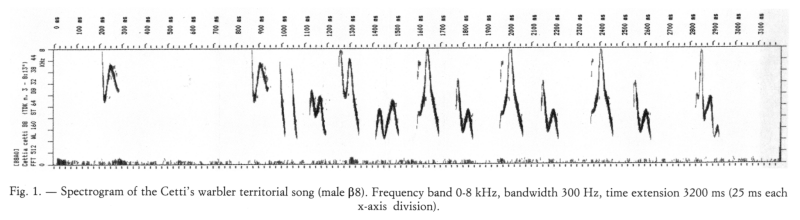
Spectrogram printed with a simple dot matrix printer
(1987).
The software allowed to print continuous spectrogram
on inexpensive continuous perforated sheets.
Shades of gray were produced by multipass
printing.
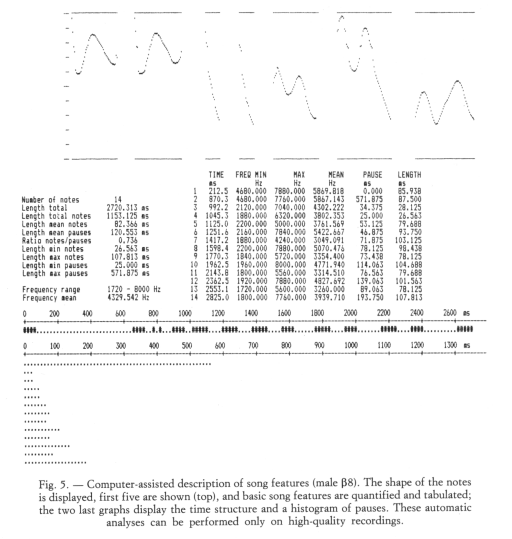
A successful example of automatic song parsing
(1987).
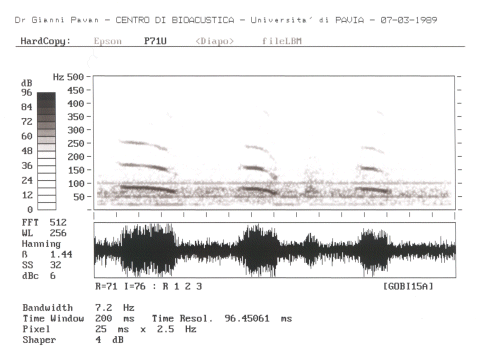
A dedicated driver was developed to
print on LaserJet printers
and on the thermal printer Mitsubishi P71U,
the same used by the Kay Sonagraph DSP5500 (1989).
The first real-time portable system
to be used in the field was developed in 1990 by
integrating in a portable PC (EPSON PC AX3s Portable,
8086SX + 808387, 16MHz, 2MB RAM, 40MB HD) a high
quality audio board along with a DSP based signal
acquisition board Microstar DAP 2400 (12 bit AD, max
250K samples/sec, a Motorola DSP 56001 and an Intel
CPU on board) for real-time processing and high speed
data acquisition. The system was called Portable DSPW
- Digital Signal Processing Workstation.
In the same period, the Intel 486 CPU with integrated
FPU, allowed a desktop PC working in real-time up to
48000 samples/sec without the need for a costly and
difficult to program DSP processor.
A great leap in the development of the DSPW was the
availability of two high quality sound boards designed
by Audiologic, a small Italian company dedicated to
the development of high quality audio systems and
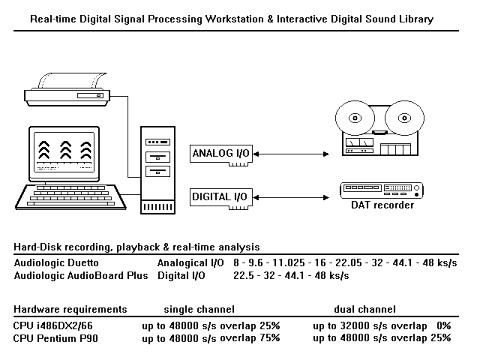
speech synthesis systems. The two ISA boards -
Audiologic Duetto (analog I/O up to 48k s/sec, mono or
stereo) and Audiologic Audioboard Plus (SPDIF digital
I/O) allowed for the first time to bring DAT quality
to a PC. A custom driver developed by Audiologic to
match our needs allowed to integrate the boards in the
DSPW to allow continuous, gap free, recording to hard
disk with real-time sound analysis and display.
Another great leap in field studies was the
availability of portable DAT recorders at reasonable
prices. The page describing the system we developed
and used in the period 1990-1994 is still available to
provide a more
detailed description.
|

The Portable DSPW with the
base to host
I/O and DSP boards (1990)
Scheme of the desktop DSPW
as conceived in 1990 >>
|
|
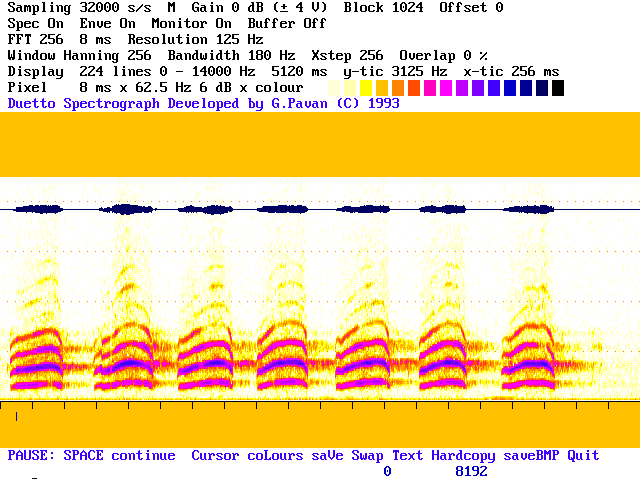
Screen shot from the
real-time Duetto Spectrograph based on the
Audiologic board (1993)
Another experimentation
made possible by real-time processing and
display capabilities, was joining video to
audio and spectrograms. A desktop PC was
fitted with a video overlay board and a
sound acquisition board to show a live video
on the PC screen along with a real-time
spectrogram. The system was later modified
by adding a VGA to video converter and a
video mixer to produce video tapes
integrating a HiFi sound channel, a live
video and a real-time spectrogram. This
system was extensively used at the Genova
Aquarium to study the vocal behaviour of a
newborn bottlenose dolphin and to associate
sounds with visible behaviours.

Real-time spectrogram
with a live video of a vocalizing young
dolphin (1994, research made at the Genova
Aquarium)
The introduction of Pentium
processors definitively moved the PC into the
real-time arena.
In 1995, to make available to other labs the
basic capabilities of the DSPW, the software -
still in DOS - was improved to use the
Creative Sound Blaster series (16/32/64). It
was made available for free on the internet
with the name SBRTA (Sound Blaster Real Time
Analyzer).
In 1996, four different working versions of
the DSPW were available, the difference being
mainly in the supported board for sound I/O:
- Microstar DAP 2400/3000/3200 (analog I/O up
to 769k s/sec)
- Audiologic Duetto (analog I/O up to 48k
s/sec, mono or stereo) & Audiologic
Audioboard Plus (digital I/O - SPDIF, mono or
stereo)
- Creative Sound Blaster boards 16/32/64
(analog I/O up to 44.1k s/sec, mono or stereo)
- Zefiro ZA2 (digital I/O - SPDIF, AES/EBU,
TosLink - mono or stereo)
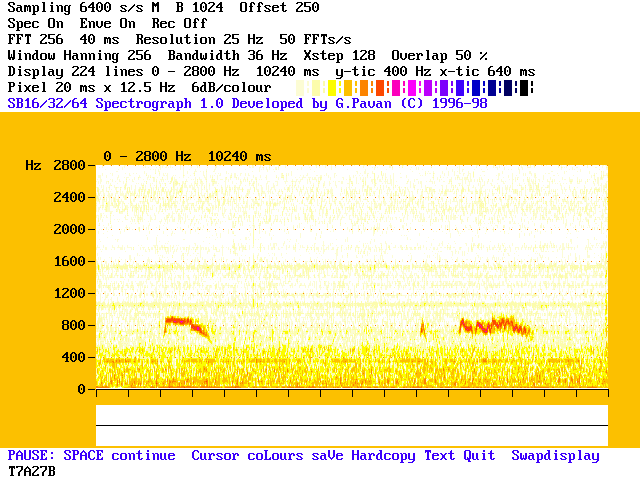
The latest version of the
SBRTA software (1996), still available for
free download.
Since then, the continuous
increase in CPU speed made the analysis of
sounds faster and faster. In 1996, a Pentium
233 required only 200 msec to display a
spectrogram of 1 second of sound sampled at
48000 samples/sec thus making it possible to
work in real-time up to 250K samples/sec.
Other than speed increase,
the latest development of multimedia PCs offer
a wide range of powerful audio interfaces with
disk storage capacity increasing month by
month. The high quality audio interfaces now
available for both desktop and notebooks PC
now outperform even the DAT recorders and
allow to setup a powerful sound analyisis and
recording system on a notebook.
 The SBRTA software
developed in 1995 is still working in many
labs, though, starting with 1997, a completely
new system, based on the Windows platform, was
designed and developed to take advantage of
all the features of Windows based systems,
mainly the independency from the hardware,
both for acquiring sounds and displaying
graphs. The new software, named wSpecGram,
was completely operative in 1998. Then, with
the fast Pentium CPUs, the high quality sound
devices made available by a globally expanding
market of multimedia products, the hard disks
able to hold up to 100GB, it was possible to
do almost everything on a cheap notebook:
multichannel sound recording and real-time
display, recording and analysis of ultrasounds
up to 400 kHz. The SBRTA software
developed in 1995 is still working in many
labs, though, starting with 1997, a completely
new system, based on the Windows platform, was
designed and developed to take advantage of
all the features of Windows based systems,
mainly the independency from the hardware,
both for acquiring sounds and displaying
graphs. The new software, named wSpecGram,
was completely operative in 1998. Then, with
the fast Pentium CPUs, the high quality sound
devices made available by a globally expanding
market of multimedia products, the hard disks
able to hold up to 100GB, it was possible to
do almost everything on a cheap notebook:
multichannel sound recording and real-time
display, recording and analysis of ultrasounds
up to 400 kHz.
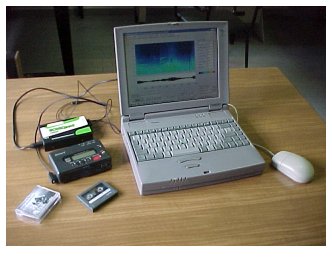
A PII 233MHz notebook with
the very first USB digital audio interface
made by OPCODE and a DAT SONY D7 (1998).
Then we started thinking to
new challenges such as realtime beamforming,
sound localization and sound classification...
A whole bioacoustic laboratory in a notebook.
A dream become true.
Gianni Pavan (C) 2001 - Comments are
welcome!
This article covers the period
1980-1999. The features of the current
versions of the Digital Signal Processing
Workstation are described in the pages on
the equipment
and software developed by CIBRA.
CIBRA Home
Page
Page created by G.Pavan,
2001. Revised March 2005.
|
|