Università degli Studi di PaviaCentro Interdisciplinare di Bioacustica e Ricerche AmbientaliVia Taramelli 24 - 27100 Pavia - Italyemail : cibra@unipv.it The Mediterranean SeaThe Mediterranean Sea is an intercontinental sea situated between Europe to the north, Africa to the south, and Asia to the east. It covers an area,
including the Sea of Marmara but excluding the
Black Sea, of about 970,000 square miles
(2,512,000 square km). It has an east to west extent of some
3860 km and a maximum width of about 1600 km.
Generally shallow, with an average depth of 1500
m, it reaches a maximum depth of 5150 m off the
southern coast of Greece.
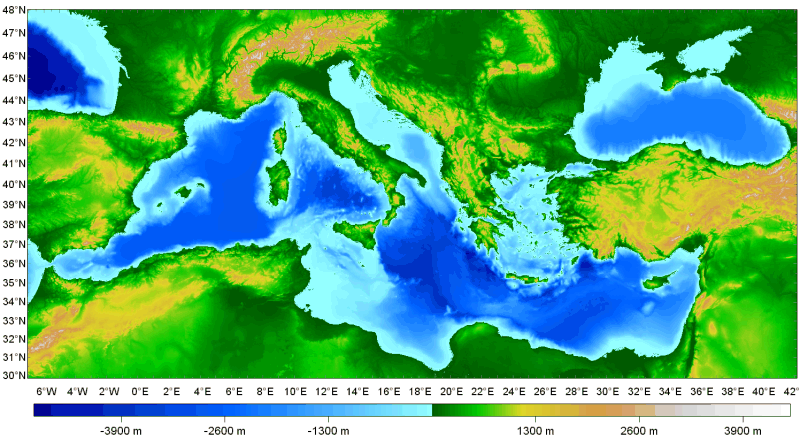
Topographic and bathymetric map of the Mediterranean basin (map produced with OceanMap by combining a number of different datasets). Marine MammalsIn the
Mediterranean Sea, 19 species of cetaceans can be
encountered; 8 of them are considered common (Fin
whale Balaenoptera physalus, Sperm whale
Physeter macrocephalus, Striped dolphin Stenella
coeruleoalba, Risso's dolphin Grampus
griseus, long finned Pilot whale Globicephala
melas, Bottlenose dolphin Tursiops
truncatus, Common dolphin Delphinus
delphis, Cuvier's beaked whale Ziphius
cavirostris), while 4 are occasional (Minke
whale Balaenoptera acutorostrata, Killer
whale Orcinus orca, False killer whale Pseudorca
crassidens, Rough toothed dolphin Steno
bredanesis), and 6 accidental, alien to the
Mediterranean, but occasionally sighted in the last
120 years (among them the Humpback whale Megaptera
novaeangliae); moreover, we have to consider
the presence of a small population of Harbour
porpoise Phocoena phocoena in the Black Sea.
A table shows the scientific
names along with the common names in different
languages. The Mediterranean Monk Seal (Monachus
monachus) is the only pinniped to be found
within the Mediterranean Sea. It is now very rare
and listed as an endangered species. The only known
colonies are in the Alboran Basin and in the Aegean
Sea. It is very unlikely that any animals will be
encountered around Sicily or Malta.
Ecological concernsIn the Mediterranan Sea
marine life is heavily threatened by habitat
degradation mostly due to human activities, such as
fisheries, ship traffic, water pollution, coastal
anthropization.
The cetacean population are currently affected by heavy pollution which contaminates the marine food web, by overexploitation of marine resources due to unsustainable and not selective fishery, and also by direct and indirect take of cetaceans. Also, we have to consider that the Mediterranean and the Black Sea form an integrated oceanographic system. The waters of the Black Sea, which are at a higher level than those of the Mediterranean, flow into the Mediterranean basin through the Bosphorus, the Sea of Marmara and the Dardanelles. The Black Sea collects waters coming from an enormous drainage basin wich includes a large part of central and east Europe and Turkey. Due to the pollution brought mainly by rivers, the Black Sea is dying; as its polluted waters continuosly flow into the Mediterranean, all marine life, ecological balance and biological resources are seriously threatened in the whole system. To the west the Mediterranean Sea is connected to the Atlantic Ocean by the Strait of Gibraltar, which at its narrowest point is only 8 miles (13 km) wide and has a relatively shallow channel. The effect of anthropogenic noise on the marine environment is a new serious concern for scientists. The effects of intense sounds on marine mammals can vary from physical damage including temporary or permanent hearing loss to a variety of potentially, still unknown, disruptive behavioral effects which may have an impact on the status of the stocks. Marine mammals extensively rely on sound to communicate, navigate, orientate, to find food and avoid obstacles. The scarce availability of baseline scientific information about cause-effect relationships prevents the adoption of appropriate conservation policies. Very little is known about the critical habitat requirements of marine mammals. The lack of adequate knowledge about the cetacean population in terms of distribution, size, trends, dynamics, reproductive cycles, migratory habits, sensitivity to human activities, ecological roles, communication abilities, dramatically limits the ability to develop strategies and policies for their conservation. This makes all cetacean species particularly vulnerable to increased disturbance and habitat degradation. Other than general principles of environmental protection, strong regulation measures are urgently needed in order to increase our awareness about critical habitat requirements and to reduce direct and indirect impacts caused by human activities. The SanctuaryIn 1993 the Ministers of the Environment
of France and Italy, and the Minister of State of the
Monaco Principality, signed in Brussels a joint
declaration for the institution of a Mediterranean
Sanctuary for the protection and conservation of
marine mammals. Updated August 2005. |