
Università degli Studi di Pavia
Centro Interdisciplinare di Bioacustica e Ricerche Ambientali
Via Taramelli 24 - 27100 Pavia - Italyemail : cibra@unipv.it
Bioacoustics
Bioacoustics is a branch of zoology, strictly related to ethology, that investigates sound production and reception in animals, including man, and how animals communicate by means of sound. Bioacoustics also concerns the organs of hearing and the sound producing apparata as well as the physiological processes by which sounds are produced and received for communication as well as for echolocation purposes. Finally, it attempts to understand relationships between the features of the sounds an animal produces and the nature of the environment in which they are used and the functions they are designed to serve. Its development dates effectively from about 1950, when practical recording and analyzing methods became readily available to the scientific community.
Soundscapes
As a landscape is what we visually perceive of an environment; a soundscape is the acoustic perception of an environment. A soundscape is created by all the sounds generated by the elements composing the environment; a natural soundscape includes all the animal voices and noises (biophony), and all the noises generated by the other natural components of the environment: the wind, the water flows, the rain, etc (geophony).
A soundscape can include sounds and noises produced by the human presence and activities (antropophony); in some case those sounds add further details to the acoustic picture, but in other cases thay may disturb animal life, and human beings too.
Natural soundscapes can be contaminated
by the noise produced by human activities and the noise
may interfere with the communicative sounds used by
animals (masking) and may have an impact on their life.
High noise levels may have a severe impact on natural
habitats; this is particularly true in underwater habitats
where sound propagates well and animals use sound as a
primary system to communicate, navigate and find food.
Ecoacoustics
Bioacoustics studies the use
of sound in animals, their acoustic communication,
echolocation and
sensing behaviours.
Ecoacoustics
is an
interdisciplinary science that investigates natural
and anthropogenic sounds
and their relationship with the environment over a
wide range of study scales,
both spatial and temporal, including
populations and
communities. Ecoacoustics operates in all
types of terrestrial and
aquatic (freshwater and marine) ecosystems extending
the scope of acoustics and
bioacoustics to ecology.
Ecoacoustics
studies all the
sound that compose the soundscape
or acoustic
environment. The
soundscape includes the sounds produced by animals (biophony), natural sounds and noises
produced by the physical
environment (geophony)
and those
produced by human activities (anthropophony).
Ecoacoustics recognizes that
sounds can be both the subject and tools of
ecological research. As the
subject, sounds are investigated in order to
understand their evolution,
functions and properties under environmental
pressures. As tools, sounds are
used to study and monitor animal diversity,
abundance, behaviour, dynamics and
distribution, and their relationship with ecosystems
and the environment.
Bioacoustics
and ecoacoustics
are rapidly evolving disciplines with important
applications in the study and monitoring
of both terrestrial and marine habitats.
Soundscape Project
The soundscapes project began at CIBRA
with the European Nature Conservation Year (ENCY) in 1995.
In 2004 CIBRA and "Parco Pineta di Appiano Gentile e
Tradate" signed an agreement to cooperate for the study
and valorization of natural soundscapes even in those
areas where the human presence and noises can be heard.
The agreement included the realization of a bioacoustic
section, entitled "The voices of Nature" at the Natural
History Museum "Antonio Stoppani" in Venegono (CO). (download a paper, in
italian .pdf).
Within the frame of the Soundscape Project, CIBRA promotes
the valorization of educational trails where to discover
valuable natural habitats and listen to nature sounds. See
the page on educational
trails  .
.
In 2013 CIBRA and University of Toloun (F) started a
cooperative project to explore the use of new hardware and
software technologies to study animal sounds and
soundscapes. This was the foundation of the SABIOD
Project. Within this Project a tight collaboration has
been established with the Italian Forestry Service (Corpo
Forestale dello Stato - CFS) to develop a SABIOD-Italy program to
study the soundscapes of nature reserves managed by CFS
through their offices for the conservation of biodiversity
(CFS-UTB). The program started in 2014 in the Integral
Nature Reserve of Sassofratino, in the core of the
National Park "Foreste Casentinesi".
CD on birds songs of the "Parco Pineta"
The first product of the Project was an
AudioCD with sound recordings of the species and of the
soundscapes of the "Parco Pineta". It was made by Guido
Pinoli and Gianni Pavan for the Parco Pineta with the
purpose of widening the awareness about the beauty of the
voices of the nature and of the silence. The CD will be
used as an educational support for the visits to the Parco
Pineta.


This CD is available in a limited number of copies. To get your copy for 12€ (including shipping) write to gianni.pavan@gmail.com
Samples from the CD
Sample tracks have been encoded in MP3 at 320kbit/sec. If by clicking on the track number nothing happens, use the right mouse button and choose "download object" to save the track on your hard-disk.
[Track 53] Marsh tit, Cincia bigia, Parus palustris

[Track 54] Coal tit, Cincia mora, Parus ater

[Track 10] Blue tit, Cinciarella, Parus caeruleus

[Track 39] Chiffchaff, Luì piccolo, Phylloscopus collybita

[Track 52] Great tit, Cinciallegra, Parus major

Ornithological Trail "Walter Corti"
The second product of the Project is the creation of the ornithological trail "Walter Corti" in the Regional Park "Parco delle Orobie Valtellinesi"; a map illustrates the trail, the habitats and the species that can be observed and heard. A software on a pocketpc equipped with a gps gives information according to the section of the trail. A CDROM and a website ( http://www.sentierocorti.it ) are also available with the map, the habitat and species descriptions, the songs in MP3 format along with the spectrographic pictures. This product has been granted by the Park Administration.
Valsolda, the songs trail "La Via dei Canti"
A third project to be completed by September is a guide, a booklet with a CD-Audio, that illustrates the trails to visit the Regional Reserve "Foresta Regionale Valsolda"; The main trail, named "Via dei Canti", is equipped with informative panels on the singing birds. The songs are on the CD and the spectrographic images, along with the other informative materials, are also available on a dedicated website. At the entrance of the reserve a panel illustrates the trail and a solar-powered MP3 player allows to listen to the songs of the typical species to be encountered. The work has been granted by ERSAF, the regional forestry agency.
Web pages, in
italian, on the Valsolda soundscapes' trails
Downloadable
MP3 Files


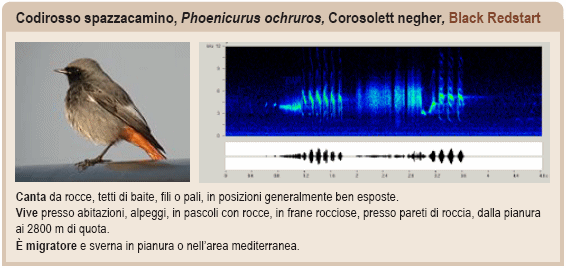

Exhibit on Pietro Pavesi (1844-1907)
A temporary exhibit (October-December
2007) at the University of Pavia will illustrate the
studies carried out by the zoologist Pietro Pavesi who
teached at the University of Pavia at the end of XIX
century. A multimedial exhibit allows to listen to the
sounds of birds living in the area when Pavesi teached in
Pavia as well as to today's species and soundscapes.
Voices of the "Garzaia", the typical nesting site of
herons
Produced by Elena Simoni and Gianni Pavan
for the Province of Pavia Administration. The enclosed CD
contains original recordings made by Gianni Pavan, Guido
Pinoli, Marco Pesente.


Recordings on SoundCloud : Garzaia
soundscape
- birds chatting 1 - Garzaia
soundscape - birds chatting 2
Regional Sound Library "Fonoteca Zoologica Regionale"
A Sound Library dedicated to collect
sound recordings of species and habitats of our region has
been created at CIBRA with the support of the regional
government. The aim is twofold: to preserve valuable
recordings made by researchers through years of studies,
and to use the recorded materials to support both
research, e.g.. for monitoring biodiversity, and
education.

 |
Recording of background noise and of biological sources in the area of the "Parco Pineta di Tradate e Appiano Gentile" . |
 |
Noise measures taken with a high quality phonometer to characterize the contamination from anthropogenic noise sources. Road traffic, even if far, and airplane traffic, heavily affects the soundscape quality of natural habitats. |
 |
By using a parabolic reflector it is possible to focus on specific sound sources and minimize the sound and noises coming from other directions. The Telinga parabola equipped with the Telinga stereo microphone allows to capture individual sound sources while retaining some spatial information to make the recording more natural and pleasant. |
 |
Soundscape recording with a matched pair of low-noise microphones in ORTF configuration; these microphones have been chosen because of the very low self noise rated at a bit less than 6dB(A). Recording is done with a Sound Devices 722, an excellent hard-disc/CF recorder with very quiet microphone preamplifiers. The recordings made with this microphone-recorder combination are completely hiss-free. Unfortunately in many natural habitats far road traffic and airplanes heavily dominate the background noise.
|
 |
Soundscape recording with a pair of Rode NT1A connected to a PocketPC recorder. |
 |
PocketPc recorder based on CoreSound Mic2496 + CoreSound PDAudio CF + Live2496 recording software. The Mic2496 electronics have been adapted to a new custom made case with XLR connectors and additional internal batteries. |
 |
Laptop-based recording is useful for multichannel recording or if scheduling is required. Additional batteries and a solar panel provide extended working duration. |
 |
Recording river noise. Mercantour National Park
(F). |
 |
Recording with the Telinga parabola. Mercantour National Park (F). Photo courtesy of Philippe Aimar. |